
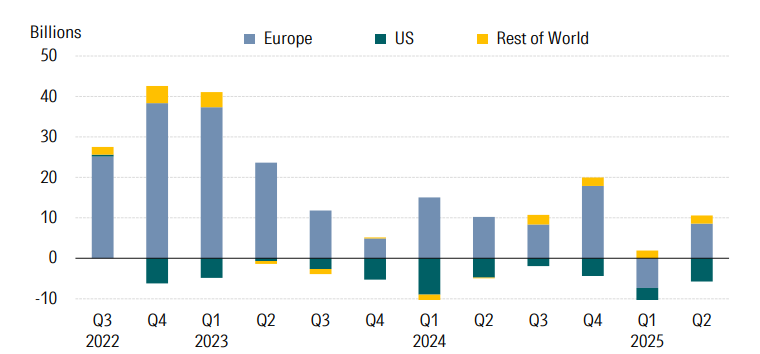
Recent data has illuminated a remarkable trend in the U.S. stock market: over $500 billion has flowed into Environmental, Social, and Governance (ESG) Exchange-Traded Funds (ETFs) in just the past year. This surge reflects not only a shift in investor sentiment but also a broader transformation in how capital is allocated within the financial markets. As inflationary pressures persist and interest rates remain elevated, the implications of this trend warrant careful consideration.
The macroeconomic backdrop is critical to understanding this influx of funds into ESG ETFs. With inflation rates hovering around multi-decade highs, investors are increasingly seeking assets that promise stability and sustainable growth. According to Bloomberg, this movement towards ESG investments aligns with a growing recognition that sustainable practices can drive long-term profitability. Firms that prioritize ESG criteria often exhibit resilience against economic downturns, making them attractive in volatile market conditions.
Moreover, the Federal Reserve’s ongoing battle against inflation has led to rising interest rates, which complicates the investment landscape. Higher borrowing costs typically dampen growth prospects for traditional sectors such as energy and manufacturing. However, ESG-oriented companies often benefit from favorable regulatory environments and consumer preferences that favor sustainability. The shift towards renewable energy sources and socially responsible practices is not merely a trend; it represents a fundamental reallocation of resources that could reshape entire industries.
As institutional investors increasingly embrace ESG principles, we see a corresponding shift in market dynamics. Large asset managers like BlackRock and Vanguard are leading the charge, integrating ESG factors into their investment strategies. According to CNBC, these firms have reported substantial inflows into their ESG-focused funds, indicating strong demand from both retail and institutional investors alike. This trend is further supported by studies showing that companies with robust ESG profiles tend to outperform their peers over time.
The technology sector has emerged as a key beneficiary of this shift. Tech companies are often at the forefront of innovation in sustainability practices, whether through energy-efficient data centers or advancements in electric vehicles. The intersection of technology and sustainability is particularly compelling; firms like Tesla have not only disrupted traditional automotive markets but have also set new standards for environmental accountability.
However, while the momentum behind ESG investing appears robust, it is essential to approach this space with caution. Not all companies claiming to adhere to ESG principles are created equal; greenwashing remains a significant concern among investors seeking genuine sustainability commitments. The challenge lies in discerning which firms are genuinely committed to these ideals versus those merely seeking to capitalize on the trend.
Furthermore, as we look ahead, potential regulatory changes may impact how ESG funds operate and report their performance metrics. The U.S. Securities and Exchange Commission (SEC) has begun exploring stricter guidelines for ESG disclosures, which could enhance transparency but also introduce new compliance challenges for fund managers.
In light of these developments, it becomes imperative for investors—especially those within the 28-45 age range who may be balancing career demands with investment ambitions—to stay informed about both macroeconomic trends and sector-specific dynamics. Understanding how these forces interact will be crucial for making informed decisions regarding portfolio allocations.
Ultimately, while the $500 billion inflow into ESG ETFs signals a significant shift towards sustainable investing, it also presents both opportunities and risks that require careful navigation. As institutional flows continue to shape market landscapes, staying attuned to evolving trends will be essential for those seeking to optimize their investment strategies amidst changing economic conditions.
For further insights on market dynamics and deeper analysis on recent rotations within sectors influenced by ESG trends, consider exploring our exclusive commentary at here.